
Global Agricultural News, Issue 107
Issue 1079月25日–10月2日
01 Farmland price gap between US and Brazil widens again
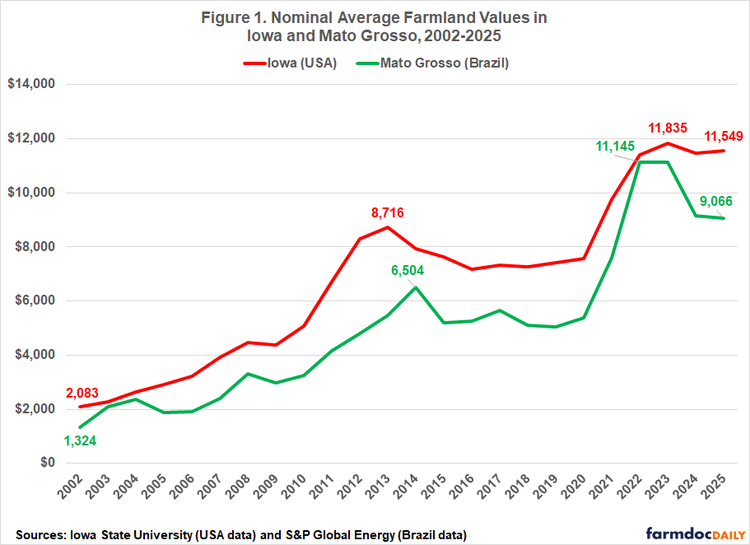
On September 25, 2026, Successful Farming reprinted the analysis article "Farmland Value and Competitiveness in the United States and Brazil" (Farmland Values and Competitiveness in the United States and Brazil) Farmdoc by the University of Illinois Agricultural Information and Research Extension Project to compare the changes in farmland value from 2002 to 2025 in Iowa and Sinop region in northern Mato Grosso, Brazil and its impact on agricultural competitiveness. The article points out that the gap in farmland values between the two places narrowed in 2021-2023, but since 2024, the value of farmland in Sinop has declined, Iowa has remained relatively stable, and the gap has widened again.
Lower land costs have long been seen as one of the competitive advantages of Brazilian agriculture over the United States. Iowa and Mato Grosso are important soybean and corn producing areas in both countries, and changes in farmland values affect not only land acquisition and lease costs, but also the funds producers need to expand their operations. Therefore, it is helpful to analyze the impact of land cost on agricultural competitiveness by comparing the farmland value and management mode of the two places.
The article shows that the value of farmland in both places has risen significantly over the long term, with Sinop growing at a higher rate, but the recent fall has widened the gap with Iowa again. From 2002 to 2025, the average annual compound growth rate of farmland value was 7.7 percent in Iowa and 8.7 percent in Sinop. In 2021-2023, rising agricultural prices led to increased agricultural earnings, and the value of farmland in the Sinop region rose rapidly, gradually approaching Iowa levels. Since 2024, as corn and soybean prices have fallen from previous highs, the value of farmland in Sinop has declined, down about 19% from its peak in 2022 in 2025, while Iowa has remained relatively stable over the same period. In 2025, the average value of farmland in Iowa will be $11549 per acre (about $11500, about 77900 yuan), while that in Sinop will be $9066 per acre (about 61200 yuan), 27% higher than the latter.
Focusing on the impact of changes in farmland value on agricultural competitiveness, the article mainly analyzes the following three aspects:(1) The cost advantage of land in some production areas in Brazil has weakened. The value of farmland in Sinop has grown faster over the long term, narrowing its land cost advantage over Iowa. However, the value of farmland in the region is still lower than Iowa in 2025, and the land cost advantage has not completely disappeared. (2) Land management methods affect cost transmission. The impact of land price increases on leaseholders and owner-owned land operators is different. The Brazilian Agricultural Census shows that about 85 per cent of the total area of agricultural business units in the country is owned land; about 3/4 of the land operated by commercial food producers in the Midwest of the United States is leased or crop-sharing. As a result, Midwestern producers in the United States are more vulnerable to rising rents, while Brazilian owner-owned land operators are more exposed to higher opportunity costs of land and increased funding for land acquisition expansion. (3) Financing costs increase operating expansion pressure. Falling prices of agricultural products, rising input costs and tighter credit have put pressure on agricultural operations and land investment in both places. Higher interest rates in Brazil have further pushed up the cost of financing land acquisitions and expanded operations, and U.S. producers are also under financial pressure from higher land prices and interest rates.
Overall, the recent decline in the value of farmland in Sinop has widened the gap with Iowa again, but the long-term rapid land price growth has narrowed its land cost advantage. The actual impact of land cost on agricultural competitiveness needs to be comprehensively judged in combination with factors such as operation mode, financing conditions, production cost and unit yield. The above analysis relates only to Iowa and the Sinop region and is not directly representative of the overall situation in the two countries.
Source: Successful Farming
Compiled by: Hu Xueping (Group B)
02 Japanese food retail market facilitation demand increases
On September 28, 2026, the U.S. Department of Agriculture's Foreign Agricultural Service (USDA FAS) released the Japan Retail Foods Annual Report (JA2026-0056) compiled by the Tokyo Agricultural Trade Office to analyze consumer trends, sales channels and market entry conditions in the Japanese retail food market. The report pointed out that in 2025, the sales of the Japanese retail market will be about 286 billion US dollars (about 1.928 trillion yuan), and the demand from supermarkets, convenience stores and pharmacies will increase, and retailers will pay more attention to the needs of young consumers.
Japan is an important global agricultural and food import market and an important export destination for U.S. agricultural products. In 2025, Japan's total agricultural imports will reach 65.8 billion US dollars (about 443.5 billion yuan), and the US agricultural exports to Japan will be 12.85 billion US dollars (about 86.61 billion yuan). Japan is the fourth largest agricultural export market of the United States. Changes in food consumption demand and sales channels in Japan have an important impact on the selection of imported food categories, product positioning and sales arrangements. This report provides a reference for American agricultural and food companies to understand the Japanese market.
The report shows that the Japanese food market mainly presents the following characteristics:(1) the expansion of frozen food consumption. The report focuses on consumer demand for easy-to-prepare, frozen and ready-to-eat foods, as well as retailers adjusting their product mix for younger consumers. According to data from the Japan Frozen Food Association, Japan's frozen food consumption in 2025 was about 3.0293 million tons, a year-on-year increase of 3.6 percent, exceeding 3 million tons for the first time; the per capita annual consumption was 24.6kg, an increase of 1.0kg over the previous year. (2) Pharmacy food sales business continued to grow. Japanese food sales channels include supermarkets, convenience stores and pharmacies, with different channels focusing on commodity structure and consumption scenarios. According to data from the Ministry of Economy, Trade and Industry of Japan, food sales in pharmacies increased by 9.1 year-on-year in 2025. Food accounted for about 1/3 of the total sales of pharmacies. Related sales have continued to grow since 2015. During the same period, sales of food and beverage products in supermarkets increased, while sales of processed food, fast food and daily food in convenience stores also increased. Food suppliers need to combine the business characteristics of different channels to arrange products and sales strategies. (3) U.S. food has a certain export base to Japan. Beef, pork, dairy products and processed foods are important categories of U.S. exports to Japan. USDA FAS data show that in 2025, US exports of beef and beef products to Japan will be US $1.76 billion (about 11.86 billion yuan), pork and pork products will be US $1.24 billion (about 8.357 billion yuan), and dairy products will be US $0.5564 billion (about 3.75 billion yuan). The report also introduces market entry methods such as establishing cooperation with Japanese importers, wholesalers and retailers, and adjusting product positioning according to local consumer tastes and consumption habits.
Overall, the expansion of frozen food consumption and the growth of food sales in pharmacies are noteworthy changes in the Japanese food market. To open up the Japanese market, food export enterprises need to combine local consumer preferences and the operating characteristics of different sales channels, optimize product allocation, and strengthen cooperation with local importers and distribution enterprises.
Source: United States Department of Agriculture
Compiled by: Kong Guojiang (Group B trainee)
03 Abnormal rainfall limits Brazilian sugar mills to increase sugar production
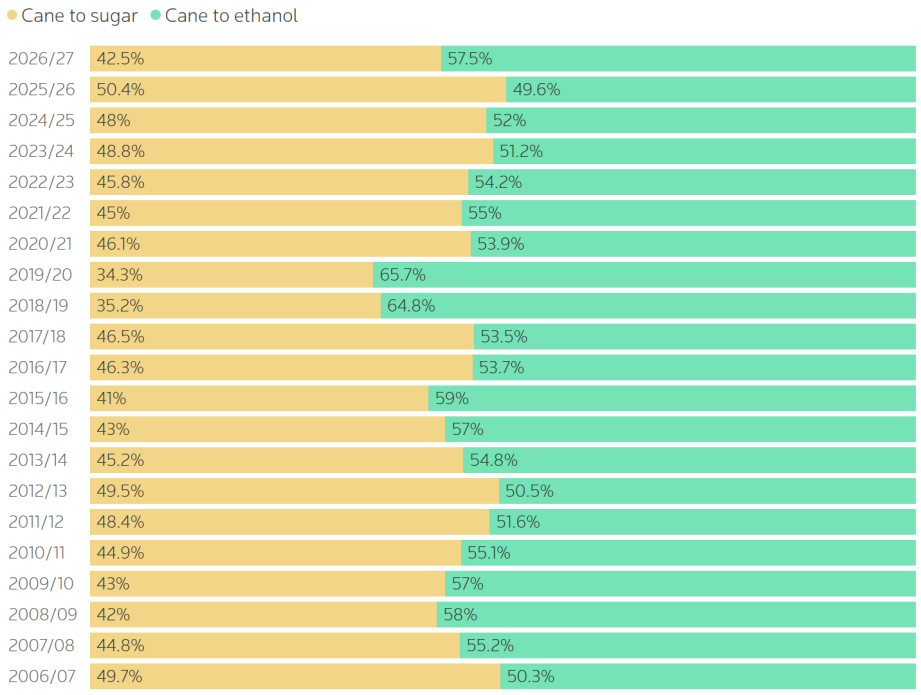
On September 29, 2026, Reuters published an analysis article titled "Weather, not price, driving the production of sugar in Brazil" (Weather, not price, to drive Brazil mills on sugar production). The article points out that the unusually wet weather against the background of strong El Nino restricts sugar mills in central and southern Brazil from increasing the proportion of sugar production according to price changes, making the distribution of sugar cane between sugar production and ethanol production more restricted by weather conditions at the end of the crushing season.
Brazil is the world's largest sugar producer and exporter, and its sugar production distribution has an important impact on the international market supply. According to estimates by the United States Department of Agriculture (USDA) in May 2026, Brazil produced about 43.8 million tons of sugar and exported about 34.1 million tons in 2025/26, accounting for 23.5 percent and 54.4 percent of the world's total respectively. Brazilian sugar mills can use sugar cane for sugar production or ethanol production, usually adjusting production ratios based on the relative benefits of the two, and changes in the use of sugar cane directly affect the amount of sugar available for sale and export.
In the early part of this season, energy prices were high and sugar prices were low. Sugar mills increased ethanol production. As of early July, the proportion of sugarcane used for sugar production was only 42.5 percent. In August, the price of international raw sugar futures rose by more than 21%; according to Veeries estimates, the consulting firm, the current income from sugar production is about 20% higher than that of ethanol, and the economic incentive to increase the proportion of sugar production is enhanced. However, continued rainfall has limited sugar mills to adjust production allocations, and sugar production increases are expected to face weather constraints.
The weather mainly restricts sugar production through two aspects:(1) rainfall delays harvesting and sugar cane processing is limited. The report quoted data from the University of Sao Paulo as saying that some of the main sugarcane producing areas in Brazil have experienced the wettest winter in more than 100 years, and the harvest progress has been affected. If the rainfall continues, the sugar mills may not be able to harvest all the available sugarcane before the end of the crushing season, limiting the increase in sugar production. (2) The sugar content of sugarcane decreased, and the adjustment of sugar production ratio was limited. The report quoted analysts as saying that high humidity promotes the growth of sugarcane plants, but reduces the concentration of sugar, making it more suitable for ethanol production than sugar, limiting sugar mills to increase the proportion of sugar production according to changes in earnings.
Harvest delays and falling sugar have compressed the sugar production space, and the market has lowered production expectations accordingly. Marcelo Bonifacio Filho, a sugar analyst at StoneX, said that judging the ratio of sugar to ethanol production at the end of the squeeze season requires more attention to weather conditions, not just market prices. The agency pointed out that the market has lowered its sugar production forecast in central and southern Brazil to below the 40 million metric tons that was expected at the beginning of the crushing season, and believes that the final output may not exceed 38 million tons. If subsequent rainfall continues, production expectations may still be further reduced.
Overall, the increase in sugar earnings is still difficult to fully translate into increased sugar production. Subsequent weather in central and southern Brazil, the progress of sugar cane harvesting and changes in the proportion of sugar will jointly affect sugar supply. If it is difficult for sugar mills to increase the proportion of sugar and some sugar cane cannot be harvested in time, international sugar prices may face further upward pressure.
Source: Reuters
Compiled by: Office
04 Russian Agricultural Group Signs 2200 Tons of Candy Supply Contract to China
On September 29, 2026, according to the Russian Agricultural Expert Network (Agroexpert), the Russian Steppe Agricultural Holding Group signed two long-term supply contracts with large Chinese distributors, and plans to supply a total of 2200 tons of candy to China in the next two years to expand the Chinese market.
Steppe is one of the largest agricultural groups in southern Russia. Its business covers planting, dairy and food production. It owns the "Мишкино" candy brand and its products have been exported to more than 50 countries. The group has previously established cooperation with Chinese distributors and expanded the market through exhibition participation and product promotion. This signing is a continuation of the existing cooperation.
China's candy and chocolate and other confectionery market is large, for Steppe to expand sales to provide market space. According to an estimate by the market research institution Deep Market, the size of China's relevant market in 2025 will be about 18.07 billion US dollars (about 121.159 billion yuan), accounting for about 8.5 per cent of the global market, and is expected to increase to 23.63 billion US dollars (about 158.439 billion yuan) by 2034.
According to the contract arrangement and subsequent planning, Steppe will promote its business in China from three aspects:(1) clear long-term supply arrangements. Both contracts are for a period of two years, which can be extended, and it is planned to complete the above supply by 2028. The main products include nut crisp sugar, soft caramel and nougat, and the categories are determined according to the results of China market research. (2) Expand online and offline channels. Related products will enter China's large-scale chain retail system, and through the main e-commerce platform and live broadcast platform sales, expand market coverage. (3) Develop products for the Chinese market. The next stage will develop a product portfolio specifically for the Chinese market according to the needs of Chinese consumers to improve product adaptability.
The signing provides a contract and channel basis for Steppe to continue to export candy to China. Subsequent contract performance, channel sales and product development will affect its business expansion in the Chinese market.
Source: Russian Network of Agricultural Experts
Compiled by: Tu Biguo (Group B)

05 South Korea to Build 100 Hectares Test Base to Promote Agricultural Machinery Intelligence
On September 30, 2026, according to the Ministry of Agriculture, Forestry, Livestock and Food of South Korea, the Ministry held a groundbreaking ceremony of the intelligent agricultural machinery test and verification base on September 29 at the Saemangeum agro-bio site in Gimje City, North Jeolla Province. The project started in 2023 with a total investment of 106.6 billion won (about 0.522 billion yuan). After planning and design and other preliminary work, the project has entered the construction stage. It is planned to build a base of about 100 hectares by 2028 to provide intelligent agricultural machinery with performance and safety test conditions in the actual agricultural environment.
The decline in the agricultural population and the deepening of aging have prompted South Korea to alleviate the shortage of agricultural labor through smart agricultural machinery. The Korea Rural Economic Research Institute predicts that in 2026, the rural household population will decrease by 1.9 to 1.945 million people year-on-year, of which the proportion of people over 65 will rise to 56.6 percent; the number of people employed in agriculture, forestry and fishery will decrease by 1.1 to 1.38 million people year-on-year. In order to support the promotion of related equipment, South Korea provides financing for the purchase of autonomous driving agricultural machinery. The number of support units will increase from 13 in 2023 to 331 in 2025, and the financing amount will increase from 1.1 billion won (about 5.39 million yuan) to 19.5 billion won (about 95.55 million yuan).
While supporting farmers to purchase equipment, South Korea has also strengthened the construction of enterprise research and development test conditions to provide technical support for the performance improvement and safe application of intelligent agricultural machinery. The base will set up demonstration fields, driving test roads and other facilities for enterprises to test the agricultural machinery under development in the actual agricultural environment, and link product development, on-site verification, performance improvement and inspection certification.
In order to further facilitate farmers to use advanced equipment, South Korea also plans to build 15 AI agricultural machinery sharing centers relying on agricultural machinery leasing agencies from 2027 and expand to 100 by 2030 to provide conditions for farmers to jointly use advanced agricultural machinery such as autonomous driving tractors.
The above arrangement combines acquisition financing, research and development verification and shared use, which helps to improve the support system for the promotion and application of intelligent agricultural machinery. Follow-up needs to pay attention to the base construction, enterprise testing and the operation of the sharing center, and evaluate the performance, safety and actual use effect of related equipment.
Source: Ministry of Agriculture, Forestry, Livestock and Food, Korea
Compiled by: Wei Jingyi (Group B)
06 South Korea's accession to CPTPP or an average annual decrease in agricultural output value of 710 billion won
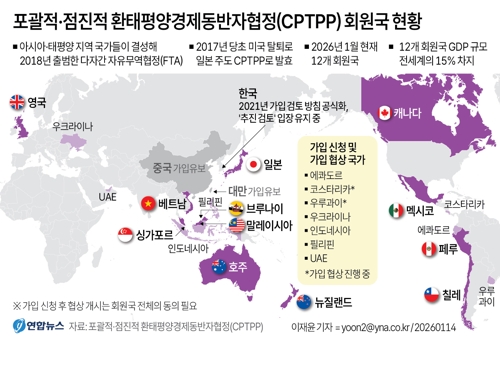
On September 28, 2026, the Ministry of Industry and Trade, the Ministry of Agriculture, Forestry, Livestock and Food, the Ministry of Marine Fisheries, the Ministry of Small and Medium-sized Venture Enterprises and the Department of Mountain Forestry jointly announced the provisional results of the economic impact analysis of joining the Comprehensive and Progressive Trans-Pacific Partnership Agreement (CPTPP). The analysis was carried out by the above-mentioned departments in conjunction with relevant research institutions, each of which is responsible for macroeconomic and industrial impact measurements. The results show that if South Korea joins the CPTPP, agricultural production is expected to decrease by 710 billion won (about 3.52 billion yuan) annually in the 15 years after the agreement takes effect, and the amount of production reduction is expected to be higher than that of forestry and aquaculture.
Before the announcement of the results, South Korea had launched social discussions and solicitation of opinions related to joining the CPTPP on August 27, and planned to judge whether to promote accession after a comprehensive assessment of the impact on national interests and people's livelihood. In response to the possible agricultural impact of accession, the Ministry of Agriculture, Forestry, Livestock and Food emphasized that relevant decisions should fully consider potential agricultural losses and listen to the opinions of the agricultural community. In order to provide a basis for the above-mentioned research and judgment, this analysis is based on the 2021 estimates, including changes in the scope of CPTPP members, trade policies of major countries and domestic and foreign industries and terms of trade, and the results will be announced in advance after the completion of the provisional estimates for discussion.
Measurements from specific research institutions include three main areas:(1) the expected macroeconomic benefits. The Korea Institute for Foreign Economic Policy predicts that 10 years after the agreement comes into effect, South Korea's real GDP will be higher than the non-accession scenario, with the announcement showing an increase of 0.38 percentage points, which is a 10-year cumulative effect. (2) Manufacturing-related production is expected to increase. The Korea Industrial Research Institute predicts that in the 15 years after the agreement comes into effect, the impact of basic production in the manufacturing industry will increase by 6.3 trillion to 6.7 trillion won (about 31.22 billion to 33.2 billion yuan), of which the impact of basic production of small and medium-sized enterprises will increase by 1.1 trillion to 1.2 trillion won (about 5.45 billion to 5.95 billion yuan). (3) The production of agriculture, forestry and water industry is expected to decrease. The Korea Rural Economic Research Institute predicts that during the same period, agricultural production will decrease by 710 billion won (about 3.52 billion yuan) and forestry production by 60.6 billion won (about 0.3 billion yuan); the Korea Marine Fisheries Development Institute predicts that aquaculture production will decrease by 81.7 billion won (about 0.4 billion yuan) per year.
The above results show that joining the CPTPP may bring overall economic benefits, and at the same time, it will make agriculture and other fields face downward pressure on production. The data are tentative projections based on specific assumptions and economic models, and the actual impact remains dependent on the level of product openness and domestic and foreign market conditions in subsequent accession negotiations. The South Korean government will continue to listen to opinions through briefings, symposiums, etc., and incorporate difficult-to-quantify impacts and industry demands into follow-up research and judgments.
Source: Ministry of Agriculture, Forestry, Livestock and Food (MAFRA)
Compiled by: Office
07 U.S. Releases September Grain Inventory Report Says Corn Inventory Increases Soybean Inventory Declines
On September 30, 2026, the U.S. Department of Agriculture's National Agricultural Statistics Service (USDA NASS) released its Grain Stocks Report. According to the report, as of September 1, 2026, changes in U.S. inventories of major food and oil crops were diverging: old crop corn inventories increased 35 percent year-on-year, while old crop soybean and total wheat inventories fell 3 percent and 14 percent, respectively.
Corn, wheat and soybeans are the main food and oil crops in the United States, and their inventory changes are important indicators to observe the periodic supply and demand situation. NASS publishes a quarterly Grain Inventory Report, which counts farm and non-farm inventories separately, on March 1, June 1, September 1 and December 1. This report mainly reflects the following three changes:(1) corn stocks increased year-on-year. U.S. stocks of old-crop corn were 2.1 billion bushels (about 53.22 million tons), up 35% year-on-year. Among them, farm inventory was 0.787 billion bushels (about 20 million tons), an increase of 22% year-on-year; non-farm inventory was 1.31 billion bushels (about 33.22 million tons), an increase of 44% year-on-year. The apparent disappearance of corn from June to August 2026 was 3.2 billion bushels (about 81.28 million tons), up from 3.1 billion bushels (about 78.74 million tons) in the same period last year. (2) Soybean stocks fell year-on-year. U.S. stocks of old-crop soybeans were 0.315 billion bushels (about 8.58 million tons), down 3% year-on-year. Among them, farm inventory is 90.4 million bushels (about 2.46 million tons) and non-farm inventory is 0.225 billion bushels (about 6.12 million tons). The apparent disappearance of soybeans from June to August 2026 was 0.744 billion bushels (about 20.25 million tons), up from 0.683 billion bushels (about 18.59 million tons) in the same period last year. (3) Wheat stocks fell year-on-year. Total U.S. wheat stocks were 1.85 billion bushels (about 50.23 million tons), down 14% year-on-year. Among them, farm inventory is 0.547 billion bushels (about 14.87 million tons) and non-farm inventory is 1.3 billion bushels (about 35.36 million tons). The Small Grains Annual Summary released on the same day showed that total U.S. wheat production in 2026 was 1.53 billion bushels (about 41.74 million tons), down 23% from the revised 2025 production.
The report provides a basis for assessing the supply base of major U.S. food and oil crops. Subsequent changes in supply and demand also need to be combined with the new season crop production, domestic use and export situation.
Source: United States Department of Agriculture (USDA)
Compiled by: Liang Mengxi (Group B)
08 China Fufeng Group promotes 3 million-ton corn deep processing industrial park project in Kazakhstan
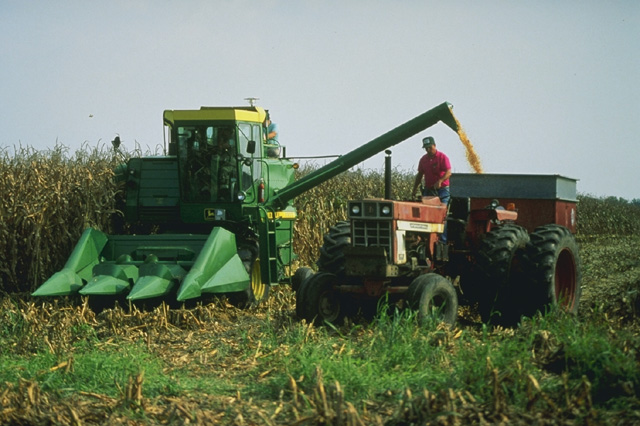
On September 25, 2026, according to the Kazakh International News Agency, Kazakh President Tokayev participated in the launching ceremony of the construction of the corn deep processing industrial park in Jiangpur Prefecture through a video link during the Kazakhstan China Investment Forum. The project is invested and constructed by China Fufeng Group. The annual processing capacity of corn in the first phase is 500000 tons, and the second phase is planned to increase to 3 million tons, focusing on the production of high value-added biological fermentation products such as amino acids.
Expanding the processing and export of agricultural products is an important direction for the development of Kazakhstan's agricultural industry. According to data from the Ministry of Agriculture of Kazakhstan, in 2025, the country's agro-industrial complex product exports reached US $7 billion (approximately RMB 46.935 billion), a year-on-year increase of 37%; of which, the export of processed products was US $3.6 billion (approximately RMB 24.138 billion)., Accounting for more than half. In order to further expand its deep processing capacity, the country plans to implement six large-scale grain deep processing projects by 2029, with a total annual processing capacity of about 5.8 million tons and a total investment of about 4 billion US dollars (about 26.82 billion yuan).
In order to introduce processing technology and expand production capacity, Kazakhstan has listed grain deep processing as a key investment field, and introduced related enterprises through targeted investment. Fufeng Group is a leading enterprise in the field of biological fermentation in China, mainly engaged in monosodium glutamate, xanthan gum and amino acids, with agricultural raw material deep processing technology and large-scale production capacity, its corn deep processing industrial park has become the first large-scale project under the mechanism.
Focusing on the construction of processing capacity, the project will also expand the product market and raw material procurement channels, including three aspects:(1) expand the processing capacity by stages. The first phase will invest 0.35 billion US dollars (about 2.347 billion yuan) to process 500000 tons of corn annually after completion; the second phase plans to invest 1.15 billion US dollars (about 7.711 billion yuan) to increase the annual processing capacity to 3 million tons and expand the product category. (2) Development of high value-added products. According to Kazakhstan's previously announced plan, the project products include lysine, glutamine, glutamic acid, leucine and threonine, which are used in food production and animal nutrition, mainly for the European, North African and Middle East markets. (3) the establishment of raw material supply cooperation. In order to ensure the supply of processing raw materials, Fufeng plans to carry out long-term cooperation with local farmers, purchase corn through procurement contracts, and provide fertilizer and modern agricultural technical support to provide farmers with a stable market.
According to Kazakhstan, after the completion of the industrial park, it is expected to create about 1500 jobs and form a complete corn deep processing production chain. The project is expected to combine the supply of local agricultural raw materials with Fufeng biological fermentation technology, expand the production and export of high value-added products, promote planting, processing and employment, and deepen China-Kazakhstan agricultural industry cooperation.
Source: Kazakh International News Agency
Compiled by: Tu Biguo (Group B)

09 The UK's food and drink trade deficit rose to £21.1 billion in the first half of the year, the highest since 2000
On September 25, 2026, the British Food and Drink Federation (FDF) released the "Food and Drink Trade Overview for the First Half of 2026" (Trade Snapshot H1 2026). The report shows that the UK's food and beverage exports fell and imports remained high. The trade deficit in the first half of the year widened to 21.1 billion pounds (about 187.334 billion yuan), a record high for the same period since 2000.
The UK's food, feed and beverage trade has been in deficit for a long time. In recent years, the trend of exports and imports has diverged, and the deficit has expanded. According to the UK Department for Environment, Food and Rural Affairs, exports have generally tended to decline and imports have generally tended to rise since 2019, on a trade price-adjusted basis. In 2025, imports were 67.8 billion pounds (601.956 billion yuan), an increase of 4.8 percent over the same period last year; exports were 25.7 billion pounds (228.175 billion yuan), down 0.9 percent from the same period last year; and the annual trade deficit reached 42.1 billion pounds (373.781 billion yuan), an increase of 8.6 percent over the same period last year. In the first half of 2026, the food and beverage trade continued to show a decline in exports and a high level of imports.
The changes reflected in this report include two main aspects:(1) exports and exports have declined. UK food and beverage exports fell 3.4 per cent year-on-year to 12 billion pounds (106.541 billion yuan), while exports in kilograms fell 11.7 per cent year-on-year to about 4 billion kilograms, the third lowest level since 2000 and only slightly higher than the same period in 2002 during the new crown epidemic in 2021 and after the foot-and-mouth epidemic in 2001. By market, exports to the EU fell by 0.9 per cent and to non-EU markets by 6.9 per cent, of which exports to the United States fell by 16.5 per cent and to the United Arab Emirates by nearly 1/4. (2) Imports increased and imports remained high. During the same period, food and beverage imports increased by 0.9 year-on-year to 33.1 billion pounds (about 293.875 billion yuan); imports measured by kilograms were 19.1 billion kilograms, the second highest level in the same period since 2000, and only lower than the same period in 2025. In terms of sources, non-EU food imports increased by 22% compared to the same period in 2023, and Australia's food and beverage exports to the UK increased by 25% year-on-year.
The decline in exports and the high level of imports have raised concerns about local production capacity in the UK's food and agriculture industry. The FDF called on the government to improve the domestic investment environment, simplify supervision, and adjust tariff and trade policies to support local manufacturing and exports; the British National Farmers Union called for a long-term plan to support local food production.
Source: The Guardian
Compiled by: Tu Biguo (Group B)
| Name | Unit | Major | Degree | Grade |
|---|---|---|---|---|
| Hu Xueping | Nanjing Agricultural University | International Business | Master students | 2026 level |
| Wei Jingyi | Nanjing Agricultural University | International Trade | Doctoral students | 2026 level |
| Sun Weikang | Nanjing Agricultural University | International Trade | Master students | 2026 level |
| Tu Biguo | Nanjing Agricultural University | International Trade | Master students | 2026 level |
| Kong Guojiang | Nanjing Agricultural University | Agricultural Management | Master students | 2026 level |
| Xinmiao Zhang | Nanjing Agricultural University | Agricultural and Forestry Economic Management | Undergraduate students | 2024 level |
| Liang Mengxi | Nanjing Agricultural University | International Economy and Trade | Undergraduate students | 2023 level |
Compiled by: Nanjing Agricultural University Globalization and Agricultural and Rural Development Research Team
sponsored by: China Society for Foreign Agricultural Economics (CSFAE)
Editors: Xie Chaoping, Tian Xi
Team leaders: Wei Jingyi and Hu Xueping
Special thanks: Foreign Investment Promotion Division, Department of International Cooperation, Ministry of Agriculture and Rural Affairs
Center for Sustainable Standards, Central University of Finance and Economics
Contents9 items · Open a title in the PDF
- Farmland price gap between the United States and Brazil widens againP3
- Increased demand for food retail market facilitation in JapanP4
- Abnormal rainfall limits Brazilian sugar mills to increase sugar production ratioP6
- Russian Agricultural Group Signs 2200 Tons of Candy Supply Contract to ChinaP7
- South Korea to build 100 hectares of test base to promote intelligent agricultural machineryP8
- South Korea's accession to CPTPP or an average annual reduction of agricultural output value of 710 billion wonP9
- The United States announced the September cereal stocks report said corn stocks increased soybean stocks fellP11
- China Fufeng Group to promote Kazakhstan 3 million tons of corn deep processing industrial park projectP12
- The UK's food and drink trade deficit rose to £21.1 billion in the first half of the year, the highest since 2000.P14