
Big Country Strong Farmers: Global Agricultural Hotspot Tracking 108th Issue.
Issue 10810月3日–9日
2026:10/3-10/92026:10/3-10/9 No. 108 No. 108 Big Country Strong Agriculture
2026:10/3-10/9
2026:10/3-10/9
no. 108
no. 108
big country strong farmer
big country strong farmer
global Agricultural Hotspot Tracking Issue 108
u.S. Farm Debt Hits Record High
02 U.S. non-GMO soybean acreage ends five consecutive years of decline
03 WRI analysis says deforestation due to EU imports is concentrated in a few countries and products
04 U.S. Department of Agriculture Releases China Sugar Semi-Annual Report
US Invests $0.825 billion to Expand International Food Aid
06 South Korea's Xijie First Sugar and ADM to Set up Feed Grade Amino Acid Joint Venture
u.S. Farm Debt Hits Record High
on October 8, 2026, Reuters released an analysis article entitled "US farm debt hit a record high, official statistics or underestimate real debt" (US farm debt is at a record. Official data might be undercounting it), focusing on the impact of the growth of US farm debt scale and the expansion of non-traditional financing on debt statistics and risk assessment. According to the article, the scale of farm debt in the United States is expected to reach a record high, while the increasing use of non-traditional financing in the agricultural sector has led to a more complex assessment of the scale of debt and related risks.
The continued growth in the size of U.S. farm debt and the expansion of non-traditional financing have made it more difficult to accurately count real debt. The U.S. Department of Agriculture's Bureau of Economic Research expects U.S. farm debt to reach $605.1 billion billion (about 4.07 trillion yuan) in 2026, a nominal increase of 4.6 percent over 2025 and a real increase of 1.5 percent after inflation, while the farm debt-to-asset ratio is expected to rise from 13.34 percent to 13.54 percent over the same period. In the long run, the scale of inflation-adjusted farm debt has more than doubled from about $300 billion (about 2.02 trillion yuan) in 2000. At the same time, some of the financing obtained by farms through agricultural suppliers, agricultural machinery distributors, etc., may not be fully covered by existing statistics. This may not only mask the true financial pressure on some farms, but also make it difficult for the relevant lenders to fully judge the borrower's debt service risk. If farm operations deteriorate, suppliers and retailers who provide credit may face additional risks of financial loss and further affect the agricultural business system.
The article points out that a professor of agricultural finance at Kansas State University estimates that the "personal and other" category of debt counted by the U.S. Department of Agriculture in 2025 is about $45 billion (about 303 billion yuan), and the actual size of the related debt may reach 2 to 3 times the official statistical value of this category. According to Reuters interviews with more than 52 large-scale field crop growers in 7 states in the Midwest and southern United States, most respondents have 7 to 10 different credit lines, and some have more than 30. As some agricultural machinery dealers require farmers to open separate credit lines every time they purchase or lease new equipment, there will be multiple scattered financing arrangements under the same farm name, further increasing the difficulty of debt statistics and accounting. In addition, a study published in 2024 found that between 2001 and 2019, 14 agricultural states in the United States issued agricultural equipment debt through non-traditional lenders at a size of up to four times the official statistical value. The findings apply only to agricultural machinery and equipment debt of non-traditional lenders in specific regions and do not mean that overall U.S. farm debt is undervalued by the same percentage. In response to the relevant statistical gaps, the USDA is further understanding the relevant debt situation by cross-comparing the farmer survey with the Agricultural Service Bureau loan records, and conducting a study on the size of the non-traditional financing market, and hopes to obtain the results of the study within two years.
The scale of farm debt in the United States continues to rise, and the development of non-traditional financing makes it more difficult to accurately grasp the actual debt situation. The USDA is refining statistics and studies to assess financial pressures on farms and their potential spillover effects. If the farm's solvency deteriorates, suppliers and other agribusinesses that provide credit may also be exposed to credit risk, and related pressures may be further transmitted to the agribusiness system.
Source: Reuters
finisher: Office
02 U.S. non-GMO soybean acreage ends five consecutive years of decline
on October 5, 2026, the U.S. Soybean Export Commission (USSEC) released the 2026 Non-GMO Soybean Planting Area Study Report (Non-GMO Soybeans Acreage Study Final Report 2026). The report shows that the planting area of non-genetically modified soybeans in the United States rebounded sharply in 2026, ending a five-year downward trend. Among them, the planting area of food-grade and feed-grade categories has increased.
U.S. soybean production is dominated by genetically modified varieties, while non-genetically modified soybeans are mainly oriented to food processing, specialty feed and other market segments, and the planting scale is relatively limited. According to the USSEC's annual planting survey, the area of non-GMO soybeans planted in the United States declined for the fifth consecutive year from 2020 to 2025, from about 5 million acres to about 3.3 million acres. The main reason for this is that the relative earnings advantage of non-GMO soybeans weakened during the period of rising prices of ordinary soybeans. USSEC shows that the purchase price of ordinary soybeans rose about 48% year-on-year in 2021, while the exclusive purchase premium for food-grade non-GMO soybeans rose only 4% over the same period. In 2022, the two types of price increases will be 18% and 13% respectively. The 2024 grower survey also showed that non-GMO soybeans cost about $9 per acre to produce more than GMO soybeans, with some plots yielding 2 to 5 bushels less than GMO. The relatively limited increase in price premiums, coupled with differences in production costs and yields, has weakened farmers' enthusiasm for planting. Based on this industry background, this report combines grower and buyer research and USDA public data to analyze the planting structure, market supply and demand, and export trade of non-GMO soybeans in the United States.
The report shows that in 2026, the planting area of non-genetically modified soybeans in the United States is about 4.3 million acres, an increase of 31% year-on-year. Among them, the planting area of food-grade non-genetically modified soybeans is about 2 million acres, an increase of 40% year-on-year; the planting area of feed-grade non-genetically modified soybeans is about 2.3 million acres, an increase of 35% year-on-year. In keeping with the pace of the rebound in planting scale, the farm-side purchase premium for food-grade non-GMO soybeans has also risen: according to market monitoring data, the purchase premium for this category has risen from US $2.57 per bushel (about 17.3 yuan) in 2025 to US $2.72 (about 18.3 yuan) in 2026. From the perspective of trade flow, the export of food-grade non-GMO soybeans in the United States accounts for a relatively high proportion, with about 79% of its output supplying the international market. Japan is its largest export market, accounting for 55% of the total related exports. South Korea, Taiwan, Thailand and the European Union are also major markets. From the downstream processing use structure, food-grade non-GMO soybeans are mainly used in the production of traditional soy products, of which tofu, soy milk and natto account for 34%, 19% and 14% of the total consumption of this category, respectively.
The rebound in planting area provides a new basis for the follow-up development of the non-GMO soybean industry in the United States. In the future, the development of the non-GMO soybean industry in the United States still needs to take into account both planting income and overseas market demand. Whether the production scale can be maintained depends on the matching degree between market demand and planting return.
Source: U.S. Soybean Export Council
finisher: Office
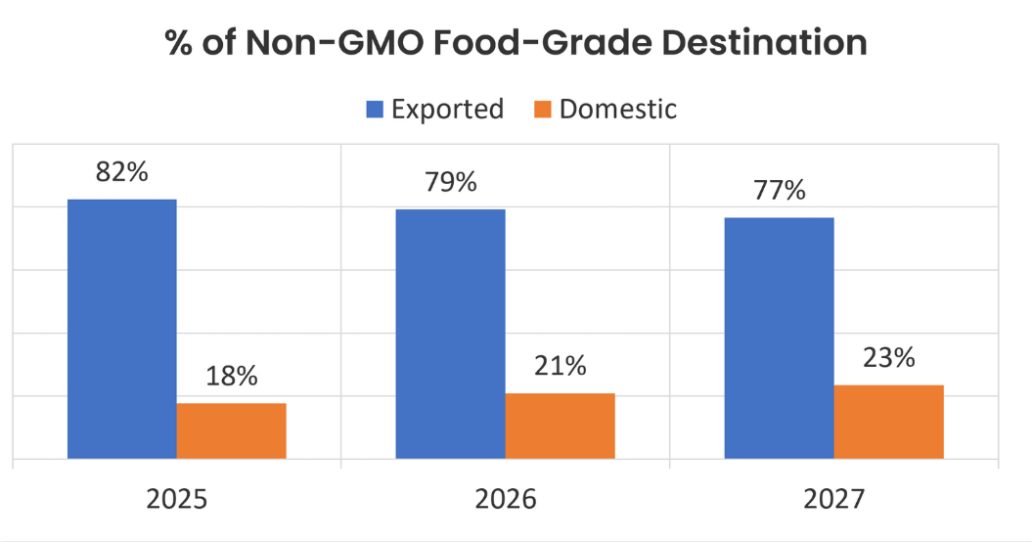
figure US Non-GMO Soybean Food Export Proportion
03 WRI analysis says deforestation due to EU imports is concentrated in a few countries and products
on October 6, 2026, the World Resources Institute (WRI) published an analysis entitled "How the EU Deforestation Policy Could Reduce Forest Loss Around the World. The article pointed out that the EU imports of beef, palm oil, soybeans, cocoa, coffee and rubber products caused 85% of the total deforestation. From the perspective of producing countries, nearly 74% of the deforestation caused by EU imports of the above six types of products and timber occurred in Côte d'Ivoire, Brazil, Indonesia, Malaysia, Ghana and Peru.
In order to reduce deforestation caused by the production of imported products, the EU passed the "EU Zero Deforestation Products Regulation" (EUDR) in 2023, which requires relevant goods to provide information on the origin when entering the EU market and prove that they meet the non-deforestation requirement. The regulations will apply to large and medium-sized operators from 30 December 2026. Due to the large variety of agricultural and forestry products imported by the EU and the wide range of producing countries involved, it is difficult to judge which specific products and producing countries have caused greater deforestation. In order to understand which regions and products the deforestation risks involved in EU imports are mainly concentrated in, and in which regions the implementation of EUDR may play a greater role, WRI selects seven types of products regulated by EUDR this time, and analyzes the main sources of deforestation caused by EU imports in combination with data on trade in agricultural and forestry products, land use and forest cover changes.
Specifically:(1) Cocoa cultivation in Côte d'Ivoire and Ghana resulted in significant forest losses. The two countries rank first and fifth respectively for deforestation caused by EU imports. Of these, the reduction in forest area in Côte d'Ivoire alone for the production of cocoa exported to Europe accounts for about 40 per cent of the total forest loss caused by EU imports. In addition, the cultivation of cocoa in the two countries has also caused some damage to the forests of the protected areas. About 37 per cent of the forest lost to cocoa cultivation in Côte d'Ivoire is in protected areas, compared with more than 13 per cent in Ghana;(2) Brazil's forest loss is mainly due to soybean and beef production. Brazil is in second place. From 2021 to 2023, the area of deforestation associated with EU imports of Brazilian soybean and beef products is about 13600 hectares and 10400 hectares per year, respectively, totaling about 24000 hectares;(3) forest loss in Indonesia and Malaysia is mainly due to palm oil. The two countries ranked third and fourth, respectively, with most of the forest loss associated with the production of palm oil. From 2021 to 2023, Indonesia's average annual deforestation area related to EU imports is about 8000 hectares, of which palm oil-related deforestation accounts for about 90%; Malaysia's average annual deforestation area is about 4000 hectares, which is also closely related to palm oil;(4) Peru's forest loss involves multiple crop production. Peru's exports to the EU resulted in an average annual forest loss of about 3900 hectares in 2021-2023, more than half of which was related to cocoa, coffee and palm oil production.
On the whole, EU import-related deforestation is mainly concentrated in a few countries and specific products, among which beef, soybean and palm oil are more prominent. With the implementation of the EUDR, traceability and supply chain review of related products will be further strengthened, and agricultural exports from major deforestation source countries will also face stricter compliance requirements.
Source: World Resources Institute
organized by: Liu Xingyu, Group A
04 U.S. Department of Agriculture Releases China Sugar Semi-Annual Report
on October 5, 2026, the U.S. Department of Agriculture's Overseas Agricultural Service (FAS) released the Sugar Semi-Annual in China. The report predicts that in 2026/27, China's sugar production will continue to grow, consumption will increase slightly, imports will decline, and the domestic sugar production and demand gap is expected to further narrow.
In recent years, China's sugar production has rebounded, but the scale of domestic consumption is still higher than production. Data show that China's sugar production increased from 11.16 million tons in 2024/25 to an estimated 12.95 million tons in 2025/26, while consumption increased from 15.39 million tons to an estimated 15.7 million tons in the same period. The gap between production and demand has narrowed, but domestic production still cannot fully meet consumer demand and needs to be supplemented by imports. The United States is an important sugar producer and importer in the world, and changes in international sugar supply and demand are closely related to its domestic market supply and trade situation. In order to grasp the dynamics of the international sugar market, the US Department of Agriculture's Overseas Agriculture Bureau (FAS) continuously tracks the supply, demand and trade of major sugar producing and consuming countries such as China, and regularly publishes relevant reports. The "China Sugar Semi-Annual Report" updated the forecast data of China's sugar production, consumption and import, providing reference for the study and judgment of international sugar supply and demand and trade changes.
The report shows four main changes:(1) the growth of domestic sugar supply. China's total sugar production in 2026/27 is expected to reach 13.37 million tons, an increase of 420000 tons from the estimate in 2025/26. Among them, driven by the expansion of sugarcane planting area in Guangxi and the increase of imported sugarcane in Yunnan, the output of sugar cane is expected to increase by 620000 tons to 12 million tons; affected by the decline of sugar beet planting income in Inner Mongolia and Xinjiang, the planting area of sugar beet is expected to decrease, and the output of sugar beet is expected to decrease by 200000 tons to 1.37 million tons. Total output will continue to grow after the increase in sugar cane production offsets the decrease in beet sugar production. (2) Consumption growth is limited. China's sugar consumption is expected to increase to 15.8 million tons in 2026/27, an increase of 100000 tons from the previous year's estimate. The report pointed out that downstream consumer demand is generally weak. Take the beverage industry as an example. In the first eight months of 2026, China's beverage production fell by 0.6 year-on-year; although the year-on-year growth in August was 0.6, the cumulative production was still lower than the same period last year. (3) Sugar imports are expected to decrease. Imports in 2026/27 are expected to drop to 3.8 million tons, a decrease of 775000 tons from the previous year's estimate. According to the report, international sugar prices are expected to remain high and domestic sugar production increases will curb imports. Industry insiders expect that the issuance of extra-quota import permits may be tightened, but it is not yet clear that the relevant new measures have been implemented. (4) Ending inventories continued to increase. According to the reported supply and demand table, China's sugar ending inventory in 2026/27 is expected to increase from 3.369 million tons estimated in the previous year to 4.579 million tons, an increase of 1.21 million tons. Despite the expected decline in imports, the increase in domestic sugar production will still push production and imports together to exceed consumption and exports, driving up inventories.
Increased sugar production, reduced imports and rising inventories will jointly affect the sugar market in China's new squeeze season. Increased domestic supply is expected to reduce import demand, but changes in international sugar prices, import policies and consumption will still affect the actual scale of imports.
Source: United States Department of Agriculture Overseas Agricultural Service
organize: Tu Biguo Group A
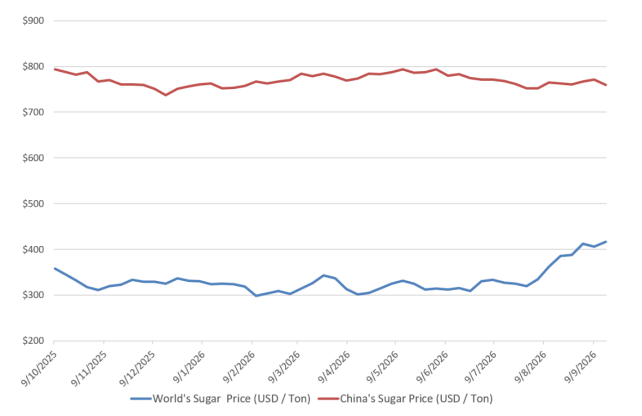
chart China and World Sugar Prices
US Invests $0.825 billion to Expand International Food Aid
on October 8, 2026, the U.S. Department of Agriculture (USDA) announced a $0.825 billion billion (about 5.555 billion yuan) investment for the implementation of the "America First" international food aid program. The move is aimed at expanding aid to food-deficit areas while increasing purchases of agricultural products from the United States.
The United States has long carried out international food aid through the purchase of local agricultural products. While alleviating food shortages in the aided areas, it also supports domestic agricultural production and agricultural product sales, and uses this to expand foreign economic and trade cooperation. In April 2024, the U.S. Department of Agriculture (USDA) and the U.S. Agency for International Development (USAID) announced the use of $1 billion in Commodity Credit Corporation (CCC) funds to purchase U.S. agricultural products for overseas emergency food assistance. In January 2025, the Trump administration announced the suspension of new foreign development aid commitments and disbursement for 90 days on the grounds that some foreign aid was not fully in line with the national interests of the United States, and reviewed the effectiveness of the project and its consistency with U.S. foreign policy. To decide on the retention, adjustment or termination of related projects. During the period under review, the United States granted temporary exemptions to humanitarian projects such as emergency food aid, allowing related projects to continue. Other suspended assistance projects were partially approved for resumption after review. Since then, while continuing to carry out international food aid, the United States has further strengthened its "America first" orientation, paying more attention to supporting the development of domestic agriculture and transportation by purchasing local agricultural products and using American transportation services. and expand long-term trade cooperation with recipient countries.
The specific arrangements for this assistance are as follows:(1) Expand emergency food aid. The Food for Peace program procures about 129000 tons of U.S. agricultural products to provide emergency food assistance to Ethiopia, Kenya, the Democratic Republic of the Congo and Haiti. The USDA has reached agreement in principle on eight projects involving $0.357 billion million in additional funding;(2) support for school feeding projects. Through the McGovern-Dole International Food Education and Child Nutrition Program (McGovern-Dole International Food for Education and Child Nutrition Program), approximately 62200 tons of U.S. agricultural products were procured for seven five-year projects in Bolivia, Cambodia, Ecuador, Guinea, Honduras, Liberia and Timor-Leste. The project plans to cover 6415 schools and improve students' nutritional status, literacy and attendance by providing meals. USDA estimates that the program will expose approximately 1.2 million children and their families to U.S. agricultural products and (3) boost the agricultural industry. The Food for Progress program, which procures approximately 311700 tons of U.S. agricultural products, modernizes agricultural value chains in Bangladesh, Bolivia, Ecuador, Morocco, Sri Lanka, Thailand, and the Philippines, improves agricultural production, processing, and distribution systems, and supports long-term trade partnerships.
USDA said that by prioritizing the purchase of U.S. agricultural products and using U.S. transportation services, international assistance can meet the food needs of recipient regions while creating economic opportunities for U.S. agricultural producers and helping recipient countries improve their self-sufficiency. The implementation effect of related projects still depends on the implementation of follow-up agreements, the progress of agricultural product procurement and transportation, and the actual implementation of aid projects in the recipient areas.
Source: USDA Foreign Agriculture Service (FAS)
finisher: Office
06 South Korea's Xijie First Sugar and ADM to Set up Feed Grade Amino Acid Joint Venture
on October 2, 2026, according to the official website of Archer Daniels Midland Company (ADM), South Korea's Xijie First Sugar Co., Ltd. (CJ) and ADM plan to set up a feed-grade amino acid joint venture in the United States. According to the relevant equity arrangement, CJ Bio America, a subsidiary of CJ, plans to hold 63% of the joint venture and ADM holds 37%. The new company intends to integrate three existing production facilities and related sales networks in the United States and Brazil to improve the production competitiveness and supply stability of feed-grade amino acids in the American market.
Lysine is an important species of feed-grade amino acids, which is widely used in livestock and poultry feed such as pigs and chickens to help supplement the nutrients needed for animal growth. The United States is one of the major consumer markets for lysine, but it is highly dependent on imports. According to IndexBox data from market research institutions, the import volume of lysine, its esters and salts in the United States in 2024 was about 80000 tons, an increase of 36% over the same period last year, accounting for about 37% of domestic consumption in that year. With the expansion of import scale, the domestic production capacity and supply chain stability of the United States have received policy attention. In June 2025, the Appropriations Committee of the U.S. House of Representatives listed amino acids as a key agricultural input in its report "Agriculture, Rural Development, Food and Drug Administration and Related Agencies Appropriations Act for Fiscal Year 2026" for fiscal year 2026, proposed to assess its dependence on imported supply, and studied measures to reduce barriers to domestic production in the United States and mitigate the risk of supply chain disruption.
In order to maintain local production, relevant companies in the United States need to improve cost competitiveness by optimizing production technology, strengthening raw material supply security and integrating sales channels. ADM is a large-scale agricultural product processing and nutrition enterprise in the United States, with grain raw material supply, processing and fermentation production capacity. In 2025, the animal nutrition business income will reach 3.325 billion billion US dollars (about 22.52 billion yuan). CJ is a Korean food and biotechnology company. Its biological business uses fermentation technology to produce and sell feed-grade amino acids. Its CJ BIO has 13 manufacturing facilities worldwide, with a fermentation capacity of more than 700000 tons and a fermentation production capacity of 8 major feed amino acids. The two sides have complementary advantages in amino acid raw material supply, facility production, technology and sales network. This cooperation improves the cost competitiveness and long-term supply capacity of local production in the United States by integrating the resources of both sides.
According to the plan announced by both parties, the new joint venture will mainly carry out the following three aspects of business:(1) Production of feed-grade amino acids. The new company will receive CJ's fermentation production facilities in Fort Dodgers, Iowa, USA and Piracicaba, Brazil, as well as ADM's feed-grade amino acid production facilities in Decatur, Illinois, USA, to integrate existing production resources and carry out feed-grade amino acid production;(2) carry out product development and technology application. The new company will be licensed to use CJ's related intellectual property rights to develop and produce feed-grade amino acid products in North and South America using its fermentation technology;(3) Responsible for sales in the Americas. The new company will integrate CJ's sales offices in the United States, Mexico and Brazil, and obtain the exclusive rights granted by both parties to produce and sell feed-grade amino acids in the Americas, and unify the regional sales of related products.
This cooperation is expected to leverage CJ's advantages in amino acid fermentation technology, as well as ADM's advantages in raw material supply and domestic production in the United States, to improve the utilization efficiency of existing production resources and the long-term supply stability of the American market. At present, the joint venture has yet to complete the relevant closing procedures and obtain regulatory approval.
Source: ADM
organizator: Zhang Shuangqin Group A

zhang Shuangqin
nanjing Agricultural University
international Business
master students
2026 level
liu Haonan
nanjing Agricultural University
international Business
master students
2026 level
pan Zihan
nanjing Agricultural University
international Business
master students
2026 level
liu Xingyu
nanjing Agricultural University
international Trade
master students
2026 level
sun Weikang
nanjing Agricultural University
international Trade
master students
2026 level
tu Biguo
nanjing Agricultural University
international Trade
master students
2026 level
sponsor: Nanjing Agricultural University "Big Country Strong Agriculture" Globalization and Agricultural and Rural Development Research Team Funding Unit: China Foreign Agricultural Economic Research Association Editor: Xie Chaoping, Tian Xi Team Leader: Luo Yaping, Zhang Shuangqin Special Thanks: Ministry of Agriculture and Rural Affairs Department of International Cooperation Foreign Investment Promotion Office Central University of Finance and Economics Sustainable Standards Research Center Sponsored: Nanjing Agricultural University "Big Country Strong Agriculture" Globalization and Agricultural and Rural Development Research Team Funding Unit: china Foreign Agricultural Economic Research Association Editor: Xie Chaoping, Tian Xi Team Leader: Luo Yaping, Zhang Shuangqin Special thanks: Department of International Cooperation, Ministry of Agriculture and Rural Affairs Foreign Investment Promotion Department, Central University of Finance and Economics Sustainable Standards Research Center
organizer: Nanjing Agricultural University "Big Country Strong Farmers" Globalization and Agricultural and Rural Development Research Team
sponsored by: China Foreign Agricultural Economic Research Association
editor: Xie Chaoping, Tian Xi
team Leader: Luo Yaping and Zhang Shuangqin
special thanks: Foreign Investment Promotion Division, Department of International Cooperation, Ministry of Agriculture and Rural Affairs
center for Sustainable Standards, Central University of Finance and Economics
organizer: Nanjing Agricultural University "Big Country Strong Farmers" Globalization and Agricultural and Rural Development Research Team
sponsored by: China Foreign Agricultural Economic Research Association
editor: Xie Chaoping, Tian Xi
team Leader: Luo Yaping and Zhang Shuangqin
Special thanks: Foreign Investment Promotion Division, Department of International Cooperation, Ministry of Agriculture and Rural Affairs
center for Sustainable Standards, Central University of Finance and Economics
Contents6 items · Open a title in the PDF
- U.S. Farm Debt Hits Record HighP3
- U.S. non-GMO soybean acreage ended five consecutive years of declineP4
- WRI analysis says deforestation caused by EU imports is concentrated in a few countries and productsP5
- U.S. Department of Agriculture Releases Semi-Annual Report on Sugar in ChinaP7
- U.S. Invests $0.825 billion to Expand International Food AidP8
- South Korea's Xijie First Sugar and ADM to set up a feed-grade amino acid joint venture.P10
Attachments
- PDFGlobal Ag News-long108(大国强农).pdf598.1 KBViewDownload