
Big Country Strong Farmers: Global Agricultural Hotspot Tracking Issue 109
Issue 10910月9日–16日
2026:10/9-10/162026:10/9-10/16 No. 109 Great Country, Strong Agriculture, Strong Agriculture
2026:10/9-10/16
2026:10/9-10/16
109th issue
109th issue
big country strong farmer
big country strong farmer
global Agricultural Hotspot Tracking Issue 109
01 Russian central bank warns of 2027 grain sowing risks
russia's sunflower seed production is expected to grow by about 9.5 in 2026
03 South Korea Releases Grape Export Strategy and Strives for Exports to Break US $0.1 billion
04 Mexico and other 7 countries launched joint prevention and control to deal with the new world spiral fly cross-border spread.
Russia Revises 2030 Agriculture and Fisheries Development Strategy and Downgrades Several Indicators
06 Oxford Economics report says EU and UK agricultural competitiveness may lag behind major world markets
01 Russian central bank warns of 2027 grain sowing risks
on October 14, 2026, the Central Bank of the Russian Federation released the report "Regional Economy: Head Office Review" (Региональная экономика: комментарии ГУ). The report shows that factors such as rising agricultural costs, tight funds, labor shortages and unfavorable weather are increasing the uncertainty of Russia's 2027 grain crop planting and production. The Russian Ministry of Agriculture has lowered its winter crop planting plan for the 2027 harvest season from 20 million hectares to 19 million hectares, reflecting the real-world pressure on winter planting next season.
Russia's grain production is expected to be generally stable in 2026, but the progress of winter planting towards the 2027 harvest season lags behind the same period last year. As of early October 2026, the winter sowing area has only completed more than 50% of the planned area, lagging behind the same period last year. At the same time, the grain harvest in 2026 is nearing completion, with a cumulative harvest of more than 0.126 billion tons of grain, including about 93 million tons of wheat (gross weight of granary). The Russian Ministry of Agriculture predicts that in 2026, the grain output will be about 0.14 billion tons and the net weight of wheat will be about 91.1 million tons. Although the grain harvest in 2026 is generally stable, the progress of winter sowing in the next season is slow. In addition to the rising cost of agricultural materials, insufficient labor and funds, and adverse weather, grain production in 2027 will still face certain pressure.
The report shows that Russia's grain production in 2027 mainly faces three pressures:(1) the rising cost of agricultural materials increases the production burden. Russian agricultural producers reported that the prices of fuel and lubricants, fertilizers, seeds, and agricultural machinery maintenance costs have risen significantly, coupled with labor shortages and insufficient funds, the burden of agricultural operations has further increased. To cover some of the costs of winter grain planting, the Russian Ministry of Agriculture is studying subsidies on a hectare basis. (2) Unfavorable weather increases the overwintering pressure of winter sowing. The regional economic report of the Russian Central Bank in October pointed out that frost, early snow and excessive soil wetting may slow down the sowing progress and affect the overwintering of winter crops. Even if the progress of subsequent planting catches up, there is still uncertainty about the final planting area and the overwintering status of crops. (3) Changes in production conditions increase production uncertainty. Restricted agricultural inputs, changes in winter sowing area and crop overwintering conditions will jointly affect food production potential in 2027, and the weather in subsequent growing seasons will further affect crop yields. It is not yet possible to judge that Russia's grain production will decline in 2027.
Overall, Russia's food production and export supply in 2027 are still uncertain. If the subsequent change in production affects the scale of exports, it may be further transmitted to the international wheat trade flow and market price, which deserves sustained attention.
Source: Central Bank of the Russian Federation
organizator: Kong Guojiang
russia's sunflower seed production is expected to grow by about 9.5 in 2026
on October 13, 2026, according to a report by the Russian Agricultural Investor Network (Agroinvestor), the RUSEED Analysis Center of Russian Agricultural Company predicts that Russian sunflower seed production will reach about 19.2 million tons in 2026, up from about 17.5 million tons in 2025. The recovery in yields in the main southern producing areas from the previous year's drought was the main factor driving the country's increase in sunflower seed production, but the reduction in production in some areas and the subsequent harvest schedule may still affect the final yield.
Sunflower seed is an important oil crop in the world, which is mainly used to produce sunflower seed oil by pressing, and the by-product sunflower seed meal can be used as feed raw materials, which plays an important role in oil processing and international trade. The U.S. Department of Agriculture estimates that the global sunflower seed crushing capacity in 2025/26 will be 49.1 million tons, the sunflower seed oil production will be 20.7 million tons, and the global sunflower seed oil export volume is expected to be 13.7 million tons. Russia and Ukraine are the world's leading producers of sunflower seeds and exporters of their processed products. According to data from the US Department of Agriculture, Russia and Ukraine together produce more than half of the world's sunflower seeds and account for nearly 3/4 of the world's sunflower oil and sunflower meal exports. In 2025, some sunflower seed producing areas in southern Russia suffered drought, and crop yields decreased significantly. In 2026, with the improvement of production conditions in the southern region, the yield of some major producing areas is expected to recover, promoting the growth of sunflower seed production in China. Other institutions also expect Russian sunflower seed production to increase. Among them, the Agricultural Market Research Institute (IKAR) expects the output to be 19.1 million tons and the ProZerno is expected to be 19.5 million tons, further indicating that market institutions generally expect Russian sunflower seed production to increase.
From the perspective of regional production, Russia's sunflower seed production in 2026 showed the following two characteristics:(1) the yield of the main southern producing areas rebounded. The yield per unit area of Rostov Oblast is expected to rise from 1.08 tons/ha in 2025 to 1.9 tons/ha, with an increase of about 800000 tons. The yield per unit area of Krasnodar Krai is expected to rise from 1.57 tons/ha to 2.61 tons/ha, with an increase of about 420000 tons. The output of Bashkortostan Republic and Stavropol Krai is expected to increase by about 200000 tons respectively. (2) Output in some areas. Production is expected to decrease by 300000 to 500000 tons in Saratov Oblast, by about 240000 tons in Samara Oblast and by about 220000 tons in Altai Krai. Among them, the reduction in production in Saratov region is related to the high production base of the previous year and the low early harvest in the left bank region; Samara and Ulyanovsk regions are affected by noctuid pests, and the Altai border region is affected by drought. As of October 13, about 50% of the sunflower seed planting area in Russia has been harvested. As the yield of the initial harvest plot is usually higher than the final average level, the subsequent national and regional yield forecasts may still be adjusted.
Overall, Russia's 2026 sunflower seed increase is expected to come mainly from the recovery of yield in the southern region, but the performance of inter-regional production is divided, and the final yield still depends on the subsequent harvest.
Source: Russian Agricultural Investor Network
organizator: Hu Xueping Group B
03 South Korea Releases Grape Export Strategy and Strives for Exports to Break US $0.1 billion
on October 15, 2026, the Ministry of Agriculture, Forestry, Livestock and Food of South Korea issued the "GRAPE Strategy" with "guarantee, strengthen, accelerate, promote, and ensure" as the core in the grape export mobilization activities, and strive to achieve an annual export value of US $0.1 billion (about RMB 0.669 billion yuan). The move aims to expand overseas sales, reduce the pressure of centralized listing on domestic prices, and provide farmers with more stable sales channels.
Korean grape exports have maintained rapid growth, but they still face problems such as relatively concentrated export markets and greater pressure on domestic centralized listings. Preliminary statistics from the Ministry of Agriculture, Forestry, Livestock and Food of South Korea show that South Korea's grape exports in 2025 were US $84.7 million (about 0.567 billion yuan), an increase of 46.3 percent over the same period last year; exports in the first half of 2026 were US $18.1 million (about 0.121 billion yuan), an increase of 27.5 percent over the same period last year. The Ministry pointed out that the increase in exports in 2025 was mainly due to the increase in production, which improved price competitiveness, and the implementation of export safety management measures to Taiwan. Among them, Taiwan is the main export market for Korean grapes. Local consumers have a high acceptance of Korean grapes and regard them as high-end fruits. This stable market demand provides support for export growth. However, in the first half of 2026, exports to Taiwan accounted for more than half, indicating that the Korean grape export market is still relatively concentrated, and it is necessary to further expand overseas markets. At the same time, the increase in domestic production has also increased the sales pressure during the centralized marketing of grapes. In response to issues such as export market expansion and domestic supply and demand adjustment, the Ministry of Agriculture, Forestry, Livestock and Food of South Korea launched the "GRAPE Strategy" to strengthen the connection of production, quarantine, logistics and sales, and promote the coordination of grape export growth and domestic market supply and demand.
In response to the main problems faced by grape exports, the "GRAPE Strategy" clarified the following five measures:(1) Implement export sources and quarantine guarantees. Relying on the grape export joint organization, 12000 tons of export sources will be implemented in advance. The number of quarantine bases for exports to the United States will be increased from 31 to 41 to improve the quarantine conditions for exports to the United States; at the same time, quarantine services will be provided on weekends and public holidays during the grape export concentration period to reduce shipment delays. (2) Increase support for export production. Increase the basic support budget for export production to 8 billion won (about 40 million yuan), promote the organizational construction of 23 professional production bases, and implement differentiated support in 2027 based on the results of export performance evaluation in 2026 to promote the production of high-quality grapes. (3) Strengthen cold chain logistics support. Increase the support funds for cold chain and logistics costs to 6 billion won (about 30 million yuan) to support low-temperature storage and transportation to ensure the export quality of grapes. (4) Carry out targeted promotion in key markets. For the US market, the focus will be on promotion from December to January of the following year; for the Taiwan market, the focus will be on the promotion of high-end gift boxes; for the ASEAN market, the promotion of anti-counterfeiting packaging, while exploring new markets such as the Philippines. (5) Improve the export transaction agreement. Promote model contracts that set out settlement methods and quality standards to reduce transaction uncertainty caused by oral agreements. Representatives of producers and export enterprises have signed contracts at the event site to clarify grape quality standards and payment settlement methods. In addition, relevant departments will organize a joint working group during the centralized listing of grapes to coordinate and solve practical problems in exports.
The Ministry of Agriculture, Forestry, Livestock and Food predicts that expanding exports during the centralized listing period will reduce the pressure on domestic supply and help improve farmers' sales prices. Production, logistics and transaction support measures will also strengthen the cooperation between farmers and export enterprises and improve the stability of export supply.
Source: Korea Ministry of Agriculture, Forestry, Livestock and Food
organizator: Tu Biguo Group B
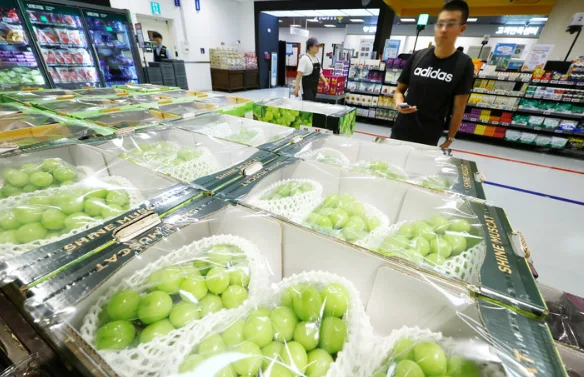
grape display cabinet in Seoul supermarket
04 Mexico and other 7 countries launched joint prevention and control to deal with the new world spiral fly cross-border spread.
On October 13, 2026, according to the Mexican Ministry of Agriculture, Mexico, Panama and other seven countries set up a regional technical group under the coordination of the Inter-American Agricultural Cooperation Institute (IICA) to start the joint prevention and control of spiral flies in the new world. The move aims to integrate national monitoring information and technical resources to improve cross-border risk identification and collaborative response capabilities.
The continued spread of the New World spiral fly epidemic in Central America and Mexico is putting multiple pressures on regional livestock production, live animal trade and animal health control systems. According to the World Organization for Animal Health, since the outbreak was reported in Pakistan in June 2023, more than 20000 outbreaks have been reported in the region through the World Animal Health Information System. The pest can cause livestock deaths, reduce meat and milk production, and increase the cost of treatment and prevention and control for farmers; the continued spread of the epidemic may also trigger transportation restrictions and trade disruptions, affect cross-border transportation and meat supply, and increase the financial burden of government monitoring, quarantine and prevention and control. Existing assessments show that the annual economic burden of the pest in South America alone is about $3.6 billion (about 24.087 billion yuan). In response to cross-border transmission and related economic risks, Mexico, Belize, Costa Rica, El Salvador, Guatemala, Honduras and Panama are strengthening monitoring, early warning and joint prevention and control through regional technical cooperation mechanisms.
The cooperation will focus on the following aspects:(1) to carry out prevention and control capacity assessment. The first meeting introduced the "Capacity Self-Assessment and Regional Baseline Building" tool, which is used to sort out the capacity of countries and provide a reference for the formulation of regional work arrangements and the definition of prevention and control priorities that are in line with the actual situation of each country;(2) strengthening regional epidemic research and assessment. Cooperation on epidemic surveillance, information analysis and risk identification to provide a technical basis for countries to determine the risk of transmission, determine prevention and control priorities, and support timely and coordinated action;(3) Promote veterinary technical cooperation. Combined with the prevention and control experience of various countries in the past two years, carry out personnel training and knowledge exchange, and enhance the technical capacity of official veterinary institutions. IICA will provide technical cooperation and institutional coordination support, and countries will continue to implement prevention and control in accordance with their own responsibilities and powers.
Overall, the cooperation between the seven countries will provide common technical support for cross-border risk research and prevention and control coordination, complementing existing measures in various countries. Through enhanced surveillance and exchange of experience, the parties aim to curb the spread of the epidemic and protect livestock and the livelihoods of families dependent on the farming industry.
Source: Ministry of Agriculture of Mexico
organizator: Tu Biguo Group B

figure New World Spiral Fly Regional Prevention and Control Technology Group Meeting Site
russia Revises 2030 Agriculture and Fisheries Development Strategy and Downgrades Several Indicators
on October 13, 2026, according to the Interfax news agency, Russian Prime Minister Mikhail Mishustin signed government decree No. 2829-р on the 9th to revise the strategy for the development of the agricultural and fishery complex of the Russian Federation (until 2030) (Стратегия the 2030 развития of the на период до of the Российской Федерации of the агропромышленного и рыбохозяйственного of the года). The revision lowered the indicators of agricultural production, agricultural land and fishery production, and added agricultural labor productivity indicators, aiming to promote agricultural technological transformation, improve labor productivity, and improve the matching degree between strategic objectives and actual implementation conditions.
The Russian government promulgated the "Strategy for the Development of the Agricultural and Fishery Complex of the Russian Federation (until 2030)" in 2022, setting indicators such as agricultural output, agricultural exports, agricultural land and fishery production, and designing basic and conservative plans. The basic plan is the main development indicators formulated on the premise that the economic environment is relatively stable and investment and technological transformation are progressing as expected. The conservative plan measures the development indicators according to the existing support policies and the slowdown of industry growth. However, in recent years, Russia's agricultural development has been lower than the original strategic expectations, and some indicators are difficult to complete even according to conservative plans. The Russian Ministry of Economic Development predicts that Russia's agricultural production index will be 98.8 per cent in 2026, down 1.2 per cent from 2025; the cumulative amount of idle agricultural land put into use by the end of 2025 will be 3.3 million hectares, only about 61 per cent of the original 2025 target. Based on the above background, the Russian government revised its development strategy and lowered some indicators to make it in line with actual production and investment conditions.
The revision mainly involves four aspects:(1) downward adjustment of agricultural output basic program indicators. The agricultural output index base programme for 2026 and 2027 was lowered from 113.8 per cent and 115.8 per cent to 112.7 per cent and 114.5 per cent, respectively;(2) the conservative programme target for agricultural land was lowered. In 2026 and 2027, the conservative plan of land area included in agricultural production was reduced from 4.2426 million hectares and 5.5949 million hectares to 4.1479 million hectares and 5.5008 million hectares respectively;(3) The indicators of fishery production base and conservative plan were reduced. The basic plan and conservative plan for 2026 catch will be reduced from 4.95 million tons and 4.85 million tons to 4.705 million tons respectively, the basic plan will be reduced from 5 million tons to 4.9 million tons in 2027, and from 5.5 million tons to 5.15 million tons in 2030. The basic plan and conservative plan for commercial aquaculture production will be reduced from 432000 tons and 410400 tons to 391000 tons and 388000 tons respectively in 2026, from 479000 tons and 425600 tons to 401000 tons and 393000 tons respectively in 2027, and from 618000 tons and 502000 tons to 446000 tons and 426000 tons respectively in 2030;(4) New agricultural labor productivity base and conservative plan indicators. Using 2023 as the base period, the basic and conservative labor productivity programmes are proposed to increase by 6 per cent and 4 per cent, respectively, in 2026, by 7.9 per cent and 6.1 per cent, respectively, in 2027, and by 12.6 per cent and 10 per cent, respectively, in 2030.
Overall, the revision mainly lowered the short-term target and aquatic products and other indicators under greater pressure, agricultural output, agricultural exports, fixed asset investment and agricultural input localization and other long-term direction remained unchanged. The adjustment helps to bring the annual target closer to reality, but it does not mean that production has declined. Whether the target can be achieved still depends on investment, technology, labor and market demand.
Source: Interfax
organized by: Liu Xingyu, Group B
06 Oxford Economics report says EU and UK agricultural competitiveness may lag behind major world markets
on October 15, 2026, according to the African Farmers Review, Oxford Economics (OE) was commissioned by Bayer to release the "Innovation in Crop Agriculture in Europe" report. The report shows that the growth rate of crop output in the European Union and the United Kingdom lags behind that of major agricultural markets such as the United States, Brazil and China. In the context of rising production costs, climate and geopolitical risks, restrictions on new varieties, plant protection products and digital agricultural technologies may further weaken European agricultural competitiveness, food supply resilience and strategic autonomy.
European agriculture is facing the twin problems of rising production costs and increasing extreme weather. According to Eurostat data, in the second quarter of 2026, EU agricultural output prices fell 5.8 per cent year-on-year, while agricultural input prices rose 4.7 per cent, with energy and fertilizer prices rising 22 per cent and 13.4 per cent respectively. At the same time, persistent high temperatures and droughts have reduced some summer crop yields by 14 per cent below the average of the past five years. This makes it more necessary for European agriculture to reduce disaster losses and improve the efficiency of input utilization with the help of drought-tolerant and high-yield varieties, new plant protection products and precision agriculture technologies. However, some agricultural technology approval procedures in the EU are complex and long, market access for new breeding technologies and plant protection products is limited, and the promotion of digital agricultural tools also faces obstacles such as cost and infrastructure. As a major global supplier of seeds and plant protection products, Bayer is pushing for the launch of gene-edited seeds, new plant protection products and digital agricultural tools, and slow EU approvals and inadequate technology adoption will directly affect its European market expansion and R & D returns. In this context, Bayer commissioned OE to carry out research to assess the competitiveness of the European planting industry and the economic benefits of agricultural innovation, in order to promote the EU and the UK to optimize the approval, accelerate the application of innovative technology to provide a basis.
The report mainly analyzes the challenges facing the European plantation industry from three aspects:(1) slow growth of crop output. The report estimates that from 2011 to 2023, the average annual growth rate of crop output in Europe is about 0.1, while that in the United Kingdom is basically no growth. During the same period, the average annual growth rate in the United States is about 1 per cent, that in China, Canada and India is 2 to 3 per cent, and that in Brazil is 3.3 per cent, indicating that the gap in crop output growth between the European Union and the United Kingdom and major agricultural producers is widening. (2) rising production costs and climate risks. The report shows that the prices of chemical fertilizers, energy and machinery and equipment in the EU will increase by 60%, 51% and 25% respectively in 2025 compared with 2020. Climate risks currently cause crop losses of about 17.4 billion euros (about 130.5 billion yuan) per year, which may increase to 24.8 billion to 28.9 billion euros (about 186 billion yuan and 216.8 billion yuan respectively) by 2050. (3) The application of pesticide technology is limited. According to the report, the number of pesticide active ingredients approved for use in the EU has dropped from more than 1000 in the early 21st century to about 420. In the past seven years, 92 licenses have been canceled, while only one new active ingredient of synthetic pesticides has entered the market in the same period. Although the UK allows 15 more than the EU, the license for these ingredients is also at risk of being revoked as the UK considers bringing it into line with EU regulatory rules.
According to the report, improving the predictability of agricultural technology approvals and promoting the use of new breeding technologies, plant protection products and digital agricultural tools will help increase agricultural productivity and enhance supply resilience in Europe. In the future, how the EU and the UK coordinate regulatory requirements between food safety, environmental protection and technological innovation will affect the promotion of related technologies and the improvement of the competitiveness of the planting industry.
Source: African Farmers Review
organized by: Liu Xingyu, Group B

hu Xueping
nanjing Agricultural University
international Business
master students
2026 level
wei Jingyi
nanjing Agricultural University
international Trade
doctoral students
2026 level
sun Weikang
nanjing Agricultural University
international Trade
master students
2026 level
tu Biguo
nanjing Agricultural University
international Trade
master students
2026 level
kong Guojiang
nanjing Agricultural University
agricultural management
master students
2026 level
xinmiao Zhang
nanjing Agricultural University
agricultural and forestry economic management
undergraduate students
2024 level
liang Mengxi
nanjing Agricultural University
international Economy and Trade
undergraduate students
2023 level
liu Xingyu
nanjing Agricultural University
international Trade
master students
2026 level
sponsor: Nanjing Agricultural University "Big Country Strong Agriculture" Globalization and Agricultural and Rural Development Research Team Funding Unit: China Foreign Agricultural Economic Research Association Editor: Xie Chaoping, Tian Xi Team Leader: Hu Xueping, Wei Jingyi Special Thanks: Ministry of Agriculture and Rural Affairs Department of International Cooperation Foreign Investment Promotion Office Central University of Finance and Economics Sustainable Standards Research Center Sponsored: Nanjing Agricultural University "Big Country Strong Agriculture" Globalization and Agricultural and Rural Development Research Team Funding Unit: china Foreign Agricultural Economic Research Association Editor: Xie Chaoping, Tian Xi Team Leader: Hu Xueping, Wei Jingyi Special thanks: Department of International Cooperation, Ministry of Agriculture and Rural Affairs Foreign Investment Promotion Department, Central University of Finance and Economics Sustainable Standards Research Center
organizer: Nanjing Agricultural University "Big Country Strong Farmers" Globalization and Agricultural and Rural Development Research Team
sponsored by: China Foreign Agricultural Economic Research Association
editor: Xie Chaoping, Tian Xi
team Leader: Hu Xueping and Wei Jingyi
special thanks: Foreign Investment Promotion Division, Department of International Cooperation, Ministry of Agriculture and Rural Affairs
center for Sustainable Standards, Central University of Finance and Economics
organizer: Nanjing Agricultural University "Big Country Strong Farmers" Globalization and Agricultural and Rural Development Research Team
sponsored by: China Foreign Agricultural Economic Research Association
editor: Xie Chaoping, Tian Xi
team Leader: Hu Xueping and Wei Jingyi
special thanks: Foreign Investment Promotion Division, Department of International Cooperation, Ministry of Agriculture and Rural Affairs
center for Sustainable Standards, Central University of Finance and Economics
Contents6 items · Open a title in the PDF
- Russia's central bank warns of risk of grain sowing in 2027P3
- Russia's sunflower seed production is expected to grow by about 9.5 in 2026P4
- South Korea Releases Grape Export Strategy and Strives for Exports to Break US $0.1 billionP5
- Mexico and other seven countries launched joint prevention and control to deal with the new world spiral fly cross-border spread.P7
- Russia revises agriculture and fisheries development strategy for 2030 and lowers several indicatorsP8
- Oxford Economics reports that EU and UK agricultural competitiveness may lag behind major world marketsP9
Attachments
- PDFGlobal Ag News-long109(大国强农).pdf631.3 KBViewDownload